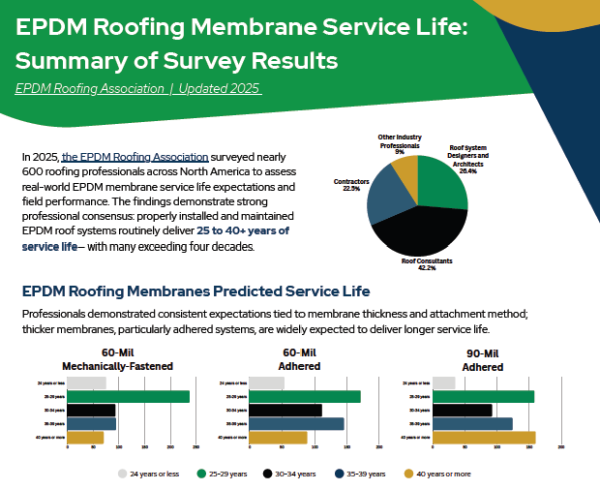
Survey of Roofing Professionals

Roof systems must perform for decades while operating in one of the most demanding environments on a building. Unlike many building components that remain sheltered within the building envelope, roofs are continuously exposed to sunlight, temperature fluctuations, wind, precipitation, and mechanical stresses. These conditions make long-term performance a central concern for building owners, designers, facility managers, architects, roof consultants, and installers responsible for managing building assets over time.
Within the roof assembly, the roof cover is the most critical component because it serves as the primary weathering surface and the first line of defense against water intrusion. To achieve the full serviceable life of a roof system, the roof cover should be capable of lasting as long as, or longer than, the other components in the assembly.
Today, many decision-makers evaluate roofing systems through a life-cycle perspective. Instead of focusing only on first cost, building owners and designers increasingly consider how roof systems perform over time. Expected service life, typically measured in years, has become a key factor in these decisions.
Determining expected service life requires multiple forms of evidence. Researchers and building professionals typically rely on a combination of accelerated aging and weathering tests, field monitoring and long-term observations, expert service-life predictions, and lifecycle-based evaluation.
EPDM has one of the longest and best-documented performance records in the low-slope roofing industry. Its history includes decades of field experience supported by laboratory testing, warranty analysis, and practitioner observations across a large installed base.
ERA’s recent service life review brings these sources together. The findings show strong alignment between field experience and published research. In ERA’s 2025 survey of 569 roofing professionals, respondents reported expected service lives ranging from about 25 years to more than 40 years depending on membrane thickness and attachment method. Many respondents also reported encountering EPDM roofs still performing at 40, 45, and even 50 years of age.
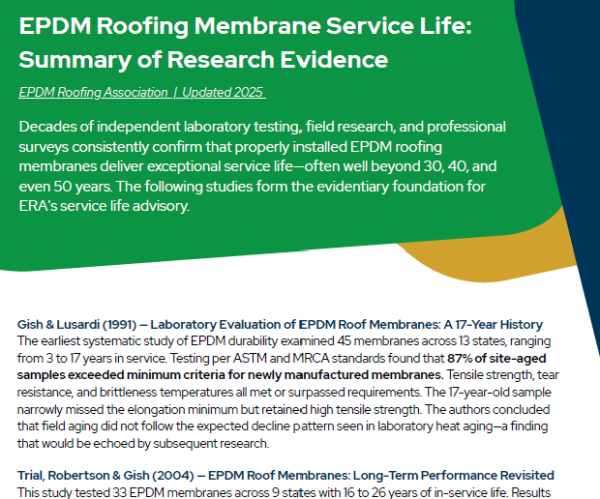
Independent studies reinforce these observations. Investigations of in-situ aged EPDM membranes in North America and Europe found that membranes with 17 to 32 years of service life remained watertight and functional and often continued to meet key physical-property requirements associated with newer material. Warranty analysis across a large installed base also shows that service calls declined as detailing and installation practices improved.
Together, these findings reinforce an important principle for the built environment: long service life results from both durable materials and sound roof system design, installation, and maintenance.
Based on the breadth of available field evidence, laboratory findings, and practitioner input, the EPDM Roofing Association is announcing that properly designed, installed, and maintained EPDM roof membranes have an expected service life of 38 years.
Supporting resources are available below, with additional research and articles in the Longevity & Long-Term Performance section of the Research & Resources area of the website.